

Stone identity report · commercial name vs. composition
Super White Dolomite: Is It Marble or Quartzite?
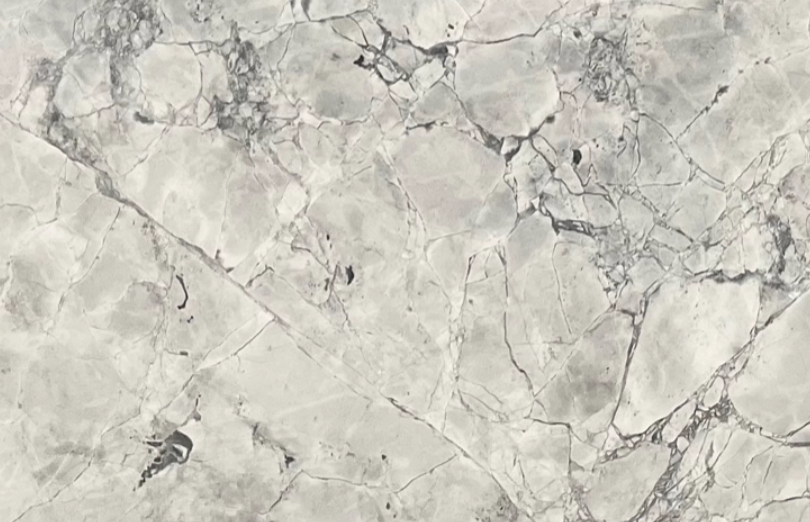
The honest answer: Super White is commonly sold under conflicting labels. MSI lists it as Brazilian marble, and many stone professionals describe commercially sold Super White as dolomitic marble. Do not price, care for or promise performance from the word “quartzite” alone.
Classification verdict
Treat Super White as an acid-sensitive natural stone unless reliable testing proves otherwise.
A sales label is not a laboratory result. The safe homeowner expectation is that Super White may etch from lemon, vinegar, wine or other acids and may need sealing based on the exact slab and finish.
What reliable listings say
The supplier record points toward marble—not guaranteed quartzite.
MSI’s official Super White product listing gives the origin as Brazil, the material type as marble, and the alternate names Moonlight and White Fantasy. Sondos Stone’s live site also places Super White Calacatta in its marble collection.
Why the confusion? Commercial stone names are not controlled geological names. A slab can move through a quarry, exporter, distributor and fabricator with a market-friendly label attached. “Dolomite,” “dolomitic marble,” “hard marble,” “granite” and “quartzite” are sometimes used inconsistently in sales conversations.
The difference matters because calcium-carbonate-rich material can react with common household acids. Quartz-rich stone is generally more acid resistant. The Natural Stone Institute recommends understanding geological classification and composition before choosing cleaning and care methods.
The evidence checklist
Five questions to ask before you approve the slab
What does the supplier call it?
Request the inventory label, material category, country of origin and any available technical information.
Was the exact slab tested?
Ask whether a sample from the material was checked for acid reaction, absorption or other relevant behavior.
What is natural or filled?
Review fissures, pits, resin-filled areas, mesh backing and any reinforcement present on the slab.
What finish is planned?
Polished stone can show etching as a dull spot. Honed finishes may make it less visually sharp, but do not prevent the reaction.
What change is acceptable?
Decide whether patina is acceptable. If the goal is a surface that looks unchanged, choose a material aligned with that expectation.
Performance profile
Beautiful, useful—and not maintenance-free.
Etching
Acids can react with calcium-carbonate-rich stone and change the finish. Etching is not the same as staining: one alters sheen; the other deposits color or oil.
Scratching
Dolomitic material can be harder than some calcitic marbles, but it should not be treated like a cutting surface. Use boards and avoid dragging abrasive objects.
Staining
Promptly blot spills. An impregnating sealer may improve stain resistance, but it does not make stone stain-proof.
Heat
Natural stone can tolerate heat, yet the Natural Stone Institute recommends trivets or mats. Protect the entire installed system, including resin and seams.
Design character
Why homeowners still choose it
Super White can deliver broad gray movement, white fields and a softer natural look than a highly controlled engineered pattern. It can bridge cool white cabinets to charcoal, stainless steel, pale wood and muted gray flooring.
The surface works best when expectations are set before installation. A homeowner who appreciates evolving natural material may love it. Someone who views every etch as damage should choose a more acid-resistant surface.
- White cabinets: compare undertones so the stone does not make the paint look yellow or blue.
- Wood cabinets: gray and white movement can cool warm oak or walnut.
- Backsplash: use a quiet tile or continue the slab when movement and budget allow.
Cost and fabrication
The price is the whole project—not one square-foot number.
Final cost depends on current slab pricing, number of slabs, usable yield, thickness, finish, sink and cooktop cutouts, edge profile, backsplash, tear-out, access and layout complexity. Natural fissures, movement and reinforcement may affect how pieces can be nested.
Ask whether the estimate includes field measurement, slab layout, fabrication, delivery, installation and the exact edge and cutout work. Compare scopes, not only totals.
Get a starting estimate →Daily-care card
Do
- Blot spills promptly.
- Use neutral stone cleaner or mild soap and water.
- Use cutting boards and trivets.
- Follow the sealer manufacturer’s directions.
Do not
- Use vinegar, lemon or acidic bathroom cleaner.
- Assume sealer prevents etching.
- Use abrasive powders without approval.
- Buy from a small sample without seeing the slab.
Frequently asked
Super White countertop FAQs
Is Super White marble or quartzite?
MSI officially lists Super White as Brazilian marble, and Sondos Stone places Super White Calacatta in its marble collection. Because trade labels vary, verify the exact slab and do not assume quartzite performance.
Where does Super White come from?
MSI lists Brazil as the country of origin for its Super White marble product.
Will Super White etch?
It may. Calcium-carbonate-rich stone can react with acids. Ask about sample testing and plan care around an acid-sensitive material unless reliable evidence says otherwise.
Does sealing stop etching?
No. Sealer can improve stain resistance, but it does not stop the chemical reaction that causes etching.
Is Super White a bad countertop?
No. It is a poor choice only when expectations are wrong. It can be an excellent natural surface for someone who understands care and accepts patina.
Sources checked